Groundwater is a regulated natural resource. For projects that require groundwater abstraction or dewatering, obtaining regulatory clearance is not simply a matter of filling an online form. Working with an accredited CGWA Groundwater NOC consultancy ensures that all technical data, hydrogeological models, and documentary evidence meet statutory benchmarks without administrative delay.
The CGWA SOP explains the application-processing framework, eligibility, mandatory documents, charges, and procedures associated with groundwater NOC applications. The SOP was developed to bring greater consistency to application evaluation and processing.
Key Takeaways
What is the BhuNeer App?
The BhuNeer App/portal provides an online interface through which project proponents and other external users can interact with the groundwater regulatory system for relevant services.
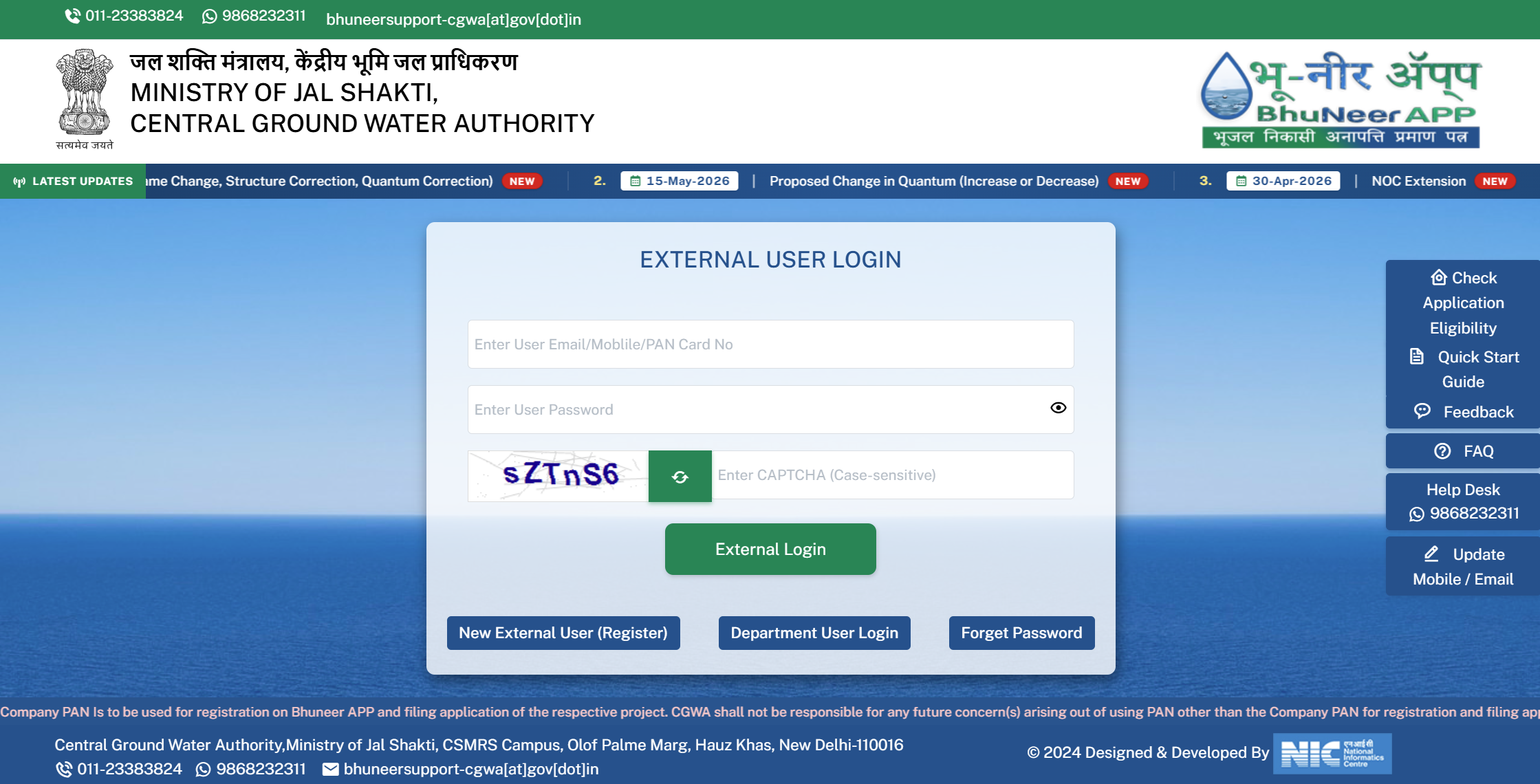
The portal provides an External User Login facility. The interface includes options for entering a user email/mobile/PAN, password, and CAPTCHA, along with facilities for new external-user registration and password recovery.
Who May Need a CGWA Groundwater NOC?
Projects involving regulated groundwater abstraction or dewatering should first determine whether a CGWA NOC or another applicable groundwater authorization is required.
The regulatory framework covers different categories of groundwater users, including industry, infrastructure, and mining projects, subject to the applicable guidelines, assessment unit status, and project-specific conditions.
Interactive BhuNeer Portal Walkthrough: Login & Registration
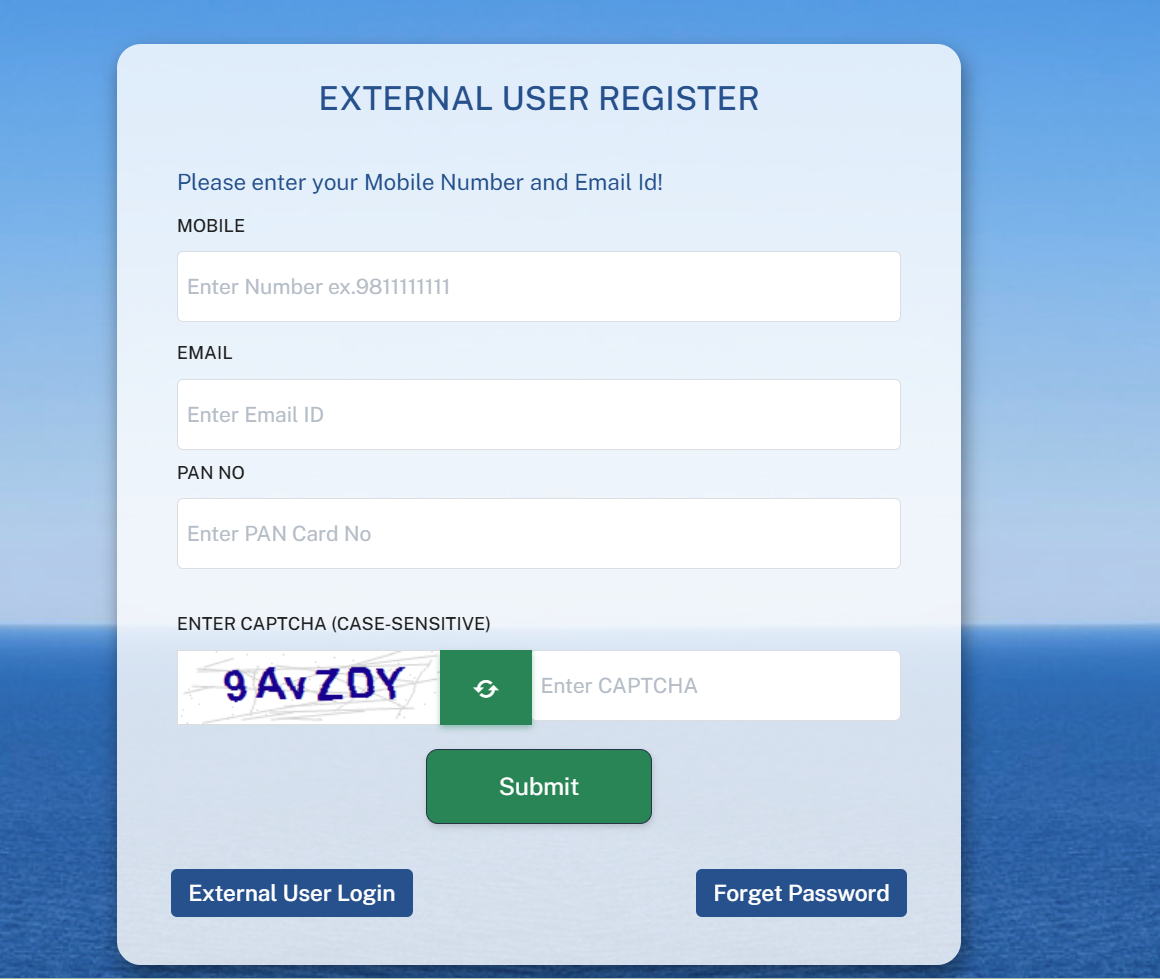
The BhuNeer portal features strict security checks. Below is an interactive walkthrough showing the official UI for both External User Login and New External User Registration. Click the tabs to switch views and tap/hover the pulsing pins for statutory warnings:
Step-by-Step Practical Sequence
Open External User Registration
From the BhuNeer login page, select “New External User (Register)”. This opens the External User Registration interface.
Enter Registered Mobile Number
Enter the mobile number that will be associated with the external-user account. Use an active number accessible during registration for OTP authentication.
Enter Official Email ID
Enter an active email address regularly monitored for application communications. A corporate domain email account is strongly recommended.
Enter Entity PAN Carefully
Where the application is being made for a company or corporate entity, the official Company PAN must be used for registration and filing.
Enter Case-Sensitive CAPTCHA
Enter the characters exactly as displayed. If unclear, use the refresh button to generate a fresh image.
Submit Registration
Review the details and click Submit. Retain your registration credentials for tracking and statutory correspondence.
What Information Should Be Prepared Before Starting a CGWA NOC Application?
Registration is only the first stage. A technically defensible application requires project documentation to be assembled prior to online submission.
Basic Project Information
- Project name and complete registered site address
- Project category (Industrial / Infrastructure / Mining)
- State, District, Block/Taluk, and Assessment Unit category
- Precise GPS coordinates of site boundaries and abstraction wells
- Existing or proposed groundwater abstraction structures
- Required groundwater quantity (m³/day and m³/year)
- Purpose of groundwater use (process, domestic, cooling, greenbelt)
- Existing NOC details and compliance returns, where applicable
Technical Information
- Hydrogeological setting and regional aquifer disposition
- Groundwater levels and pre/post-monsoon monitoring data
- Aquifer characteristics (Transmissivity, Storativity, Specific Yield)
- Groundwater quality analysis from NABL-accredited laboratories
- Recharge and abstraction calculations
- Comprehensive water balance diagram matching NBC norms
- Rainwater harvesting and artificial recharge layout plans
- Accredited Impact Assessment study information
Which Technical Reports May Be Required?
One of the most important aspects of a CGWA groundwater NOC application is compiling the technical reports mandated for your category under the CGWA SOP guidelines. High-volume units requiring more than 100 KLD must attach Impact Assessment Reports (IAR) and 3D MODFLOW numerical modeling along with comprehensive water balance analyses.
| Report / Document | Purpose | Typical Relevance |
|---|---|---|
| Impact Assessment Report (IAR) | Assesses potential impacts of groundwater abstraction or dewatering on the regional aquifer system and environmental components. | Industrial & infrastructure projects exceeding specified statutory withdrawal thresholds. |
| Comprehensive Hydrogeological Report (CHR) | Provides comprehensive hydrogeological evaluations for mining operations, spanning both core and buffer zones. | Mandatory for all mining projects intersecting or operating near the water table. |
| Groundwater Modeling Report | Numerically simulates groundwater flow dynamics and predicts drawdown scenarios using Visual MODFLOW. | Required for high-volume abstraction and dewatering under CGWA modeling standards. |
| Water Audit Report | Evaluates water consumption, metering, conservation measures, and recycling/reuse efficiency. | Mandatory for industrial units abstracting > 100 KLD. |
Impact Assessment Report: What Should It Cover?
An Impact Assessment Report (IAR) should establish a logical relationship between the project requirement, the aquifer system, proposed withdrawals, and predicted drawdowns.
Core IAR Components
- Salient features of the proposal and operational profile
- Project description and process flow overview
- Land use / land cover classification (5 km radius)
- DEM (Digital Elevation Model) and surface topography
- Regional geomorphology and drainage network
- Wetlands, rivers, and major surface water bodies
- Geological and hydrogeological framework
- Existing and proposed borewell inventories
- Proposed dewatering plan, where applicable
- Impact prediction on regional groundwater regimes
- Impact on nearby surface water interactions
- Impact on groundwater chemical quality
- Mitigation measures and artificial recharge designs
- Water balance, recycle, and reuse accounting
- Summary and hydrogeological conclusion
Why Groundwater Modeling Is Important in a CGWA Application
Groundwater numerical modeling is essential when the potential impact of abstraction or dewatering cannot be adequately characterized through analytical equations alone.
The CGWA modeling SOP outlines specific modeling objectives, including assessment of groundwater reserve dynamics, prediction of water-level drawdowns, radius of influence, surface-groundwater interactions, and mitigation strategies where unacceptable impacts are projected.
What Makes a Groundwater Model Credible?
- Site-specific hydrogeological characterization
- Sound conceptual model representing boundary conditions
- Justified finite-difference grid and vertical layer discretization
- Reliable time-series groundwater head observations
- Field-derived aquifer parameters (pumping tests)
- Accurate recharge and discharge budgeting
- Rigorous model calibration and sensitivity validation
- Multi-year predictive impact scenarios
- Transparent discussion of model assumptions and limitations
Groundwater Modeling Report Structure
Under official CGWA modeling standards, numerical modeling reports must follow a standardized chapter-wise layout:
| Chapter | Primary Focus Area |
|---|---|
| Chapter 1 | Introduction, Project Background & Modeling Objectives |
| Chapter 2 | Regional & Local Hydrogeological Characterization |
| Chapter 3 | Conceptual Model Design & Boundary Conditions |
| Chapter 4 | Numerical Groundwater Flow Model & Calibration |
| Chapter 5 | Predictive Simulations & Radius of Influence Scenarios |
| Chapter 6 | Conclusions, Mitigation Planning & Recommendations |
Water Audit Report: Why It Matters
A compliant groundwater NOC application must also demonstrate how water is consumed, where losses occur, and what percentage of effluent is treated and recycled.
Important Water Audit Focus Areas
- Process-wise and unit-wise water consumption monitoring
- Utility consumption breakdown (cooling towers, boilers, DM plants)
- Fresh water vs. recycled water consumption ratios
- Leakage detection, distribution losses, and pressure management
- ETP / STP performance and treated effluent recycling
- Rooftop rainwater harvesting potential and storage
- Water conservation opportunities and future reduction roadmaps
Common Mistakes That Can Delay a Groundwater NOC Application
Many application rejections are not caused by complex hydrogeology, but by avoidable inconsistencies across forms, maps, and reports:
1. Incorrect Groundwater Quantity
The daily and annual quantum requested in the online portal must align with the accompanying water balance calculations and hydrogeological reports.
2. Inconsistent Project Details
Ensure that the entity name, address, borewell coordinates, and plant category match across the CTE/CTO consents, land documents, and NOC submissions.
3. Poor-Quality Maps
Maps must be drawn to metric scale, with clear geographic coordinates, a north arrow, site boundaries, and a legible legend.
4. Figures Not Discussed in Narrative
Every chart, cross-section, and table inserted into technical reports must have a corresponding narrative explanation in the text.
5. Missing Data Sources
Secondary data (CGWB reports, IMD rainfall) must be properly cited, maintaining a clear distinction between field measurements and published literature.
6. Weak Hydrogeological Interpretation
Reports must provide scientific interpretations of local aquifer setups, pumping tests, flow directions, and expected drawdowns rather than generic geographic overviews.
CGWA Report Quality Checklist Before Submission
| Verification Item | Compliance Question |
|---|---|
| Project Details | Are project names, coordinates, and entity details consistent across all documents? |
| Groundwater Quantity | Does the portal quantum match the water balance and technical report? |
| Report Versioning | Are submission month, year, and revision indices clearly labeled? |
| Accreditation | Is the consultant's accreditation certificate (RGNGWTRI / QCI-NABET) attached? |
| Cartography | Are scales, coordinates, north arrows, and legends clearly visible on all maps? |
| Tables & Figures | Are all technical tables and figures numbered and discussed in the narrative? |
| Data Citations | Are secondary hydrogeological and rainfall data sources cited? |
| Calculations | Do field pumping tests, water balance math, and model inputs agree? |
| Mandatory Enclosures | Are valid SPCB consents, non-availability certificates, and NABL reports attached? |
BhuNeer Registration Is Only the Beginning
A common misconception is that obtaining portal login credentials completes the compliance effort. In reality, registration is merely the initial step, followed by rigorous technical preparation, modeling, document appraisal, and regulatory scrutiny.
Post-NOC Compliance: Mandatory Requirements After Approval
Groundwater regulations mandate ongoing monitoring after an NOC is granted. Non-compliance triggers statutory penalties and Environmental Compensation (EC) under Section 15 of the EPA, 1986.
Key Post-NOC Compliance Requirements:
- Daily log maintenance of flow meter readings
- Installation of calibrated Digital Water Flow Meters (DWFM) with telemetry
- Construction of dedicated observation piezometers with DWLR telemetry
- Periodic monitoring of pre- and post-monsoon water levels
- Construction and maintenance of artificial rainwater recharge structures
- Annual groundwater quality testing through NABL-certified laboratories
- Timely submission of annual compliance returns via the BhuNeer portal
- Filing renewal applications at least 90 days before NOC expiration
When Should You Consult a Groundwater Expert?
Professional hydrogeological consultancy is essential when projects involve complex aquifer systems, large abstraction volumes, infrastructure dewatering, mining operations, 3D numerical modeling, or regulatory non-compliance notices.
Our Core Capabilities Include:
- CGWA & SGWA groundwater NOC applicability assessments
- Turnkey BhuNeer application filing and profile management
- Comprehensive Hydrogeological Investigations & Pumping Tests
- Impact Assessment Reports (IAR) conforming to CGWA SOP standards
- Comprehensive Hydrogeological Reports (CHR) for mining operations
- 3D Numerical Groundwater Modeling (Visual MODFLOW Flex)
- Certified Water Audits & Industrial Water Balance Engineering
- Rooftop Rainwater Harvesting & Artificial Recharge Design
- Technical representation against Show Cause Notices & EC calculations
Need Direct Assistance with BhuNeer Portal Filing or Technical Reports?
NRSM provides comprehensive accredited hydrogeological consultancy across India. From initial applicability audits and BhuNeer registration to Visual MODFLOW numerical simulations and CGWA NOC compliance, our senior team ensures end-to-end statutory clearance.
Schedule a BhuNeer Compliance Consultation →Frequently Asked Questions About BhuNeer and CGWA NOC
What is BhuNeer?
What information is required for BhuNeer external-user registration?
Should a company use its Company PAN for registration?
Is BhuNeer registration enough to obtain a CGWA NOC?
Is an Impact Assessment Report important for groundwater NOC?
When is groundwater modeling required?
Why are CGWA applications sometimes returned or queried?
Before You Submit: 10-Point Final Checklist
- Confirm the correct corporate applicant and Entity PAN.
- Verify authorized signatory mobile and email OTP details.
- Confirm exact daily and annual groundwater withdrawal requirements.
- Verify GPS coordinates of all production and standby borewells.
- Compile mandatory SPCB CTE/CTO consents and non-availability certificates.
- Verify that hydrogeological reports are prepared by accredited experts.
- Ensure all technical maps include scale, north arrow, and legends.
- Verify that pumping test math aligns with numeric modeling inputs.
- Check compliance logs and flow meter records for existing borewells.
- Conduct a comprehensive review of all attachments before final submission.
Turnkey CGWA & SGWA Compliance on BhuNeer
Natural Resource Solution and Management (NRSM) provides accredited hydrogeological studies, Impact Assessment Reports (IAR), Comprehensive Hydrogeological Reports (CHR), Visual MODFLOW numerical modeling, water audits, and turnkey BhuNeer portal filing services.