CGWA & SGWA Compliance Advisory | Pan-India Liaison
⚡ COMPLIANCE ALERT
📢 Free Technical Assistance for Self-Inspection & Self-Compliance Updation on the BhuNeer Portal of CGWA for Groundwater NOC Holders.   |   Facing NOC Expiry, Penalty, or Quantum Correction? Contact Us Today →
CENTRAL GROUND WATER AUTHORITY

CGWA Compliance Portal: Groundwater NOC, BhuNeer, GWRE, Charges & Compliance

A practical regulatory resource for industries, infrastructure projects, mining projects and other groundwater users seeking guidance on CGWA groundwater NOC, BhuNeer applications, groundwater resource assessment, abstraction charges, self-compliance, inspections and technical Studies.

The Natural Resource Solution and Management CGWA Compliance Portal brings key groundwater regulatory topics together in one structured knowledge hub. Explore NOC requirements, document checklists, GWRE categories, groundwater charges, compliance requirements, BhuNeer portal guidance and technical study resources.

CGWA Groundwater Regulation
BhuNeer Portal Guidance
Technical Scientific Studies
Compliance Monitoring Support
CGWA KNOWLEDGE HUB

Explore Groundwater NOC & Compliance Resources

Access practical information covering the major stages of groundwater regulatory planning, application, compliance and technical assessment.

01 💧

CGWA Groundwater NOC

Statutory permissions for industrial, infrastructure & mining projects under CGWA & SGWA guidelines. End-to-end advisory for fresh NOC applications, BhuNeer portal renewals, MSME exemptions, and abstraction compliance.

Explore NOC Resources →
02 📋

CGWA NOC Document Checklist

Complete statutory attachment guide for BhuNeer portal filing. Sector-wise mandatory documents for Industry, Infrastructure, Mining & Bulk Water Supply across Fresh and Renewal applications.

View Document Checklist →
03 🗺️

Know Your GWRE Category

Verify assessment unit status (Safe, Semi-Critical, Critical & Over-Exploited) under CGWB reports. Live lookup across 2020–2025 historical data to determine NOC feasibility and statutory abstraction tariffs.

Explore GWRE Categories →
04 ₹

Know Your Groundwater Charges

Calculate statutory groundwater abstraction tariffs, restoration fees, Table 16.1 violation penalties, and Environmental Compensation (EC) under latest CGWA and SGWA regulatory slabs.

Explore Groundwater Charges →
05 🛡️

Self-Compliance & Inspection Hub

Mandatory 3-Phase BhuNeer compliance tracker. Verify telemetry flow meters, NABL water quality tests, piezometer DWLR hydrographs, annual water audits, and geotagged field audit evidence.

Open Compliance Hub →
06 💡

BhuNeer Portal Guides

Step-by-step statutory filing walkthroughs for the central BhuNeer portal. Company PAN registration, NOCAP data migration, self-inspection reports, Bharatkosh payments, and 60-day revival workflows.

View BhuNeer Guides →
07 🔬

CGWA Technical Studies Desk

Accredited hydrogeological investigations for statutory approvals. Submission-ready Impact Assessment Reports (IAR), Mining CHRs, calibrated 3D MODFLOW flow modeling, and certified industrial water audits.

Explore Technical Studies →
08 ❓

Statutory CGWA FAQs

Explore 20 comprehensive regulatory answers covering NOC applicability, MSME thresholds, abstraction charges, Table 16.1 penalties, and legal framework citations.

View All FAQs →
REGULATORY GUIDELINES & STATUTORY PROTOCOL

CGWA Groundwater NOC: Applicability, Exemptions & Compliance Requirements

Understand the principal requirements for groundwater abstraction permissions, assessment-unit restrictions, technical documentation and post-NOC compliance under the consolidated Ministry of Jal Shakti guidelines dated 24 September 2020, incorporating the amendment dated 29 March 2023.

Important: This is a general guidance summary, not a substitute for the notified guidelines, subsequent directions or the conditions in an individual NOC. Regulatory jurisdiction and requirements must be checked for the project location and category.

01 · Scope of Regulation

Who May Require a Groundwater NOC?

Under the applicable central or State/UT framework, new and existing projects abstracting groundwater generally need to check NOC requirements unless a specific exemption applies.

  • Industries: Manufacturing, processing, packaged drinking water, beverages, textiles, chemicals and other industrial uses.
  • Infrastructure: Applicable building and construction projects, group housing, commercial developments and other notified infrastructure activities.
  • Mining: Mining projects and groundwater abstraction or dewatering proposals, as applicable to the project.
  • Existing users and expansion: Existing abstraction, increased demand, changes in use and renewal cases should be assessed against the current permission and applicable rules.

The competent authority may be CGWA or the relevant State/UT Ground Water Authority/designated authority, depending on the location and applicable regulatory arrangement.
02 · Exemption Criteria

Who May Be Exempt?

The consolidated guidelines identify specified exempt categories. Exemption should be confirmed against the exact category, abstraction purpose and applicable conditions.

  • Individual domestic users: Groundwater use for drinking and domestic purposes in rural and urban areas.
  • Rural drinking-water supply schemes: As covered by the applicable guideline provisions.
  • Agricultural activities: Groundwater abstraction for agricultural use, subject to the applicable regulatory framework.
  • Armed Forces/CAPF establishments: Specified establishments in rural and urban areas, as provided in the guidelines.
  • Micro and small enterprises: The stated exemption covers micro and small enterprises drawing groundwater of less than 10 m³/day (10 KLD), subject to applicable provisions.

Do not assume that every MSME, every abstraction purpose or every State/UT is automatically exempt. Confirm the current rules and any registration, reporting or State-level requirements before relying on an exemption.

03 · Resource Availability

Assessment Category & Project Eligibility

Groundwater availability is assessed at the relevant assessment-unit level. The category is an important input in determining whether an application may be considered and what conditions may apply.

  • Assessment categories: Safe, Semi-Critical, Critical and Over-Exploited, as identified in the applicable groundwater resource assessment.
  • Over-Exploited units: The guidelines restrict grant of NOC for groundwater abstraction to a new industry, except industries falling within the specified MSME category. Other sector-specific provisions and conditions must also be checked.
  • Technical scrutiny: Project category, abstraction quantity, end use, water availability, recharge proposals and supporting technical documents may affect appraisal.
  • Check the exact unit: Use the correct State, district and assessment unit and verify the relevant assessment year before planning an application.
04 · NOC Conditions

Monitoring & Post-NOC Compliance

Grant of an NOC is not the end of the regulatory process. The project proponent must follow the conditions stated in the NOC and the provisions applicable to its sector and abstraction quantity.

  • Flow measurement: Install and maintain the prescribed flow meter(s) and telemetry/data transmission arrangements wherever required by the guidelines or NOC.
  • Groundwater-level monitoring: Where applicable, provide monitoring piezometers and digital water-level recording/telemetry equipment in accordance with the NOC and technical requirements.
  • Rainwater harvesting/recharge: Implement the approved or prescribed rainwater harvesting and groundwater-recharge measures, where applicable.
  • Data and reports: Maintain abstraction records and submit the required monitoring data, compliance reports, water audit reports and other returns within the specified timelines.
  • Renewal and changes: Track the NOC validity, apply for renewal in time and obtain the required permission for changes in abstraction, wells or project particulars.

Non-compliance, extraction beyond the permitted quantity or abstraction without the required permission may lead to regulatory action, penalties and/or Environmental Compensation, as applicable.

When are hydrogeological reports, modelling or water audits required?

Technical documentation is not identical for every application. The consolidated guidelines prescribe Impact Assessment Reports (IAR) and groundwater modelling for specified projects and abstraction thresholds, and water-audit requirements for applicable industrial users. Requirements depend on assessment category, geological setting, sector and quantity of groundwater abstraction. Confirm the relevant clause and current NOC conditions before finalising the scope of a report.

Read CGWB's Ground Water Regulation information ↗
GROUNDWATER NOC LIFECYCLE

From Groundwater Assessment to
NOC Compliance

A groundwater NOC should be viewed as part of an ongoing regulatory lifecycle rather than as a one-time application.

01
STAGE 01 · ASSESS

Determine Applicability

Identify the project's groundwater requirement, source, location and applicable regulatory requirements.

02
STAGE 02 · ANALYSE

Understand GWRE Category

Review the groundwater resource status of the relevant assessment unit and its significance for planning.

Check GWRE category →
03
STAGE 03 · PREPARE

Prepare Documents & Studies

Compile required documents, hydrogeological information and applicable technical reports.

View document checklist →
04
STAGE 04 · SUBMIT

Apply Through BhuNeer

Submit the applicable groundwater NOC application and supporting information through the designated portal.

Open official portal ↗
05
STAGE 05 · COMPLY

Maintain NOC Conditions

Monitor abstraction, maintain required records and follow applicable NOC conditions throughout the approval period.

06
STAGE 06 · RENEW

Prepare for Renewal

Maintain compliance records and technical documentation required for future renewal or regulatory submissions.

Need Support with a Fresh NOC, Renewal or Compliance?

NRSM provides groundwater regulatory support, application documentation, hydrogeological studies, water audits and BhuNeer compliance assistance, subject to the project scope and applicable requirements.

Request Technical Consultation

Regulatory note: Information on this page is for general awareness and is not legal advice or a guarantee of approval. Guidelines, notifications, State/UT rules and portal procedures may change. Verify the latest official documents and project-specific conditions before applying.

02 / DOCUMENTATION

CGWA NOC Document Checklist

Proper documentation is the cornerstone of a successful groundwater NOC application under Central Ground Water Authority and State Ground Water Authority frameworks.

Project-specific attachment requirements vary significantly based on sector classification, daily abstraction quantum (KLD), assessment unit category, and application purpose (Fresh vs. Renewal). Incomplete or misclassified attachments frequently cause show-cause queries, portal rejections, and administrative delays.

✓
Project & Applicant Details Ownership deeds, lease agreements, constitutional identity, and authorized signatory credentials.
✓
Groundwater Abstraction & Water Balance Quantum justification, daily KLD breakdown, flow charts, and municipal non-availability certificates.
✓
Hydrogeological Reports & Technical Studies Accredited IAR, Mining CHR, calibrated MODFLOW 3D numerical modeling, and certified water audits.
✓
Rainwater Harvesting & Groundwater Quality Geotagged RWH structure photos, runoff calculations, and NABL-accredited water testing reports.
✓
Previous NOC & Self-Compliance Dossier Mandatory for renewals: digital telemetry logs, piezometer DWLR data, and inspection returns.
INTERACTIVE DOCUMENT ENGINE

Filter Required Documents by Project Category

Select your sector and application purpose below to view the exact statutory attachment checklist.

Application Purpose:

Required Documents: Industry (Fresh Application)

Statutory attachments required for online BhuNeer portal filing.
1
Mandatory
Proof of Establishment / Project Commencement

Consent to Establish (CTE) / Consent to Operate (CTO) from State Pollution Control Board, Environmental Clearance (EC) from MoEF&CC / SEIAA, or statutory letter proving date of commencement.

2
Mandatory
Certificate of Non-Availability / Partial Availability of Water

Issued by the local government water supply agency (Municipal Corporation, PHED, RIICO, DIC) confirming municipal water is unavailable or insufficient.

3
Mandatory
Proof of Implemented Rainwater Harvesting Structure with Calculations

Geotagged site photographs, structural engineering drawings, recharge pit dimensions, and volume calculations as per Model Building Bye Laws.

4
Mandatory
Groundwater Quality Analysis Report (NABL Accredited)

Comprehensive physical, chemical, and heavy metal testing parameters from an accredited lab for water sampled from existing or nearby borewells.

5
Consult NRSM
Impact Assessment Report (IAR) with 3D MODFLOW Modeling

Statutorily mandatory for all projects abstracting > 100 KLD in Over-Exploited, Critical, and Semi-Critical blocks, or > 500 KLD (Hard Rock) / > 1000 KLD (Soft Rock) in Safe assessment units.

6
Mandatory
Wetland Authority Clearance / Buffer Affidavit

Formal approval from the State Wetland Authority if within 500 meters of a notified wetland; otherwise, a notarized non-proximity affidavit.

7
Conditional
MSME Udyam Registration Certificate

Required to claim regulatory tariff relaxations and eligible MSME abstraction exemptions under prevailing guidelines.

8
Conditional
Notified Industrial Area Allotment Proof

Allotment letter or possession certificate if situated inside state/central declared industrial estates (e.g., RIICO, GIDC, MIDC).

1
Mandatory
Copy of Previously Granted CGWA / SGWA NOC

Legible digital copy of the expiring NOC approval letter along with initial compliance annexures.

2
Mandatory
Valid Consent to Operate (CTO) from SPCB

Current operational pollution clearance confirming continuous compliant manufacturing activity.

3
Mandatory (>100 KLD)
Industrial Water Audit Report by Certified Water Auditor

Mandatory for all industrial units abstracting > 100 KLD. Includes water balance diagrams, specific consumption metrics, and conservation audits.

4
Consult NRSM
Updated Impact Assessment Report & Numerical Groundwater Model

Required if abstraction volume is being expanded or if specified under conditions of the earlier approval.

5
Mandatory
Self-Compliance Monitoring Report & Telemetry Calibration Certificate

Daily abstraction logs from digital flow meters, annual piezometer water-level records, and telemetry uptime logs.

6
Mandatory
Geotagged Photographs of Maintained RWH Structures

Visual verification showing functional desilting chambers, recharge wells, and maintenance records.

1
Mandatory
Sanctioned Building Plan & Statutory Approvals

Approved building layout from local development authority (JDA, DDA, BMC, Town Planning), Environmental Clearance (EC), or CTE.

2
Mandatory
Rainwater Harvesting Plan per Model Building Bye-Laws

Approved architect/engineering drawings showing rooftop catchment, storm drainage network, and groundwater recharge pits.

3
Mandatory
Water Supply Non-Availability Certificate

Certificate from municipal water board confirming piped municipal water connection is unavailable or delayed.

4
Mandatory
NABL Groundwater Quality Analysis Report

Standard drinking and domestic suitability test report of groundwater from existing on-site borewells.

5
If Dewatering Involved
Comprehensive Hydrogeological Impact Assessment for Dewatering

Mandatory whenever basement or foundation construction involves sub-surface dewatering (requires 5 km radius impact assessment).

6
Mandatory
Sewage Treatment Plant (STP) Dual-Plumbing Layout

Engineering schematic demonstrating recycled wastewater utilization for flushing, cooling, and landscaping.

1
Mandatory
Copy of Expiring CGWA Approval Letter

Previous NOC documentation along with original compliance verification.

2
Mandatory
Occupancy Certificate (OC) / Consent to Operate

Issued by the urban local body or SPCB confirming completed or operational residential/commercial occupancy.

3
Mandatory
Self-Compliance Report on RWH & Water Metering

Telemetry flow meter calibration records and maintenance reports for rainwater harvesting facilities.

4
Mandatory
Updated Water Quality Report from NABL Lab

Latest potability and quality test parameters from site borewells.

1
Mandatory
Approved Mining Plan with Progressive Mine Closure Plan (PMCP)

Approved by the Indian Bureau of Mines (IBM), Ministry of Coal, or State Directorate of Mines & Geology.

2
Consult NRSM
Comprehensive Hydrogeological Report (CHR) & 3D Flow Model

Bench-wise pit seepage calculations, radius of influence evaluation, drawdown forecast, and 10 km core/buffer zone numerical flow modeling.Statutorily mandatory for all projects abstracting > 100 KLD ground water

3
Mandatory
Mine Sump Dewatering Management Plan

Detailed engineering balance for pit water handling, domestic treatment, dust suppression reuse, and agricultural discharge.

4
Mandatory
Piezometer & Telemetry Monitoring Network Scheme

Design layout showing core-zone and buffer-zone piezometers equipped with automatic Digital Water Level Recorders (DWLR).

1
Mandatory
Copy of Previous CGWA Clearance Letter

Original NOC permit letter and historical compliance condition proofs.

2
Consult NRSM
Updated Hydrogeological Modeling & Water Balance Audit

Re-calibrated numerical simulation reflecting updated pit depths, current water level fluctuations, and aquifer recovery rates.

3
Mandatory
Telemetry Piezometer Logs & Pumping Records

Continuous annual time-series hydrographs and certified flow meter logs submitted through BhuNeer.

4
Conditional
Mining Scheme Revision / Expansion Approval (if applicable)

Latest approved modification if applying for increased extraction or deepening of the mine pit.

1
Mandatory
Proof of Land Ownership (Minimum 200 m²)

Registered revenue land title or registered lease deed showing clear title where the abstraction borewell is installed.

2
Mandatory
Water Tanker Registration Certificates (RC Books) & GPS Proof

Transport department registration for all operational tankers with GPS telemetry tracking capability.

3
Mandatory
NABL Groundwater Quality Report (Drinking Water IS 10500)

Comprehensive potable water lab testing proving safe human consumption standards.

4
Mandatory
Implemented Artificial Recharge Proof

RWH structures with geotagged photographic confirmation and recharge capacity evaluation.

1
Mandatory
Previous Bulk Water NOC Letter

Copy of the expiring or expired CGWA permission.

2
Mandatory
Updated Tanker Fleet Documentation

Active vehicle fitness, commercial permits, and GPS operational verification.

3
Mandatory
Water Metering & Distribution Logbooks

Records showing total groundwater drawn and dispatched to commercial/industrial consumers.

Need Accredited Assistance with Technical Reports?

NRSM prepares statutory Impact Assessment Reports (IAR), Mining CHRs, MODFLOW 3D numerical models, and certified industrial water audits pan-India.

💬 Send Checklist via WhatsApp
03 / GROUNDWATER RESOURCE ASSESSMENT (GWRA)

Know Your GWRE Groundwater Resource Category

Groundwater Resource Estimation (GWRE) provides the statutory scientific benchmark under Central Ground Water Authority regulations. Your project's assessment unit category directly dictates NOC eligibility, mandatory technical studies, abstraction tariffs, and recharge obligations.

01 Stage ≤ 70%

Safe

Groundwater extraction is within annual recharge limits with no significant long-term water level decline. Fresh NOCs are generally permissible for industrial, infrastructure, and mining activities subject to standard metering and rainwater harvesting norms.

02 Stage > 70% to 90%

Semi-Critical

Denotes moderate groundwater extraction stress. New industrial and commercial applications are scrutinized carefully. Mandatory water conservation plans, artificial recharge structures, and higher abstraction charges apply under Table 16.1.

03 Stage > 90% to 100%

Critical

Represents severe aquifer stress approaching extractable limits. Stringent regulatory appraisal requires comprehensive hydrogeological impact reports, digital flow telemetry, and substantial groundwater restoration fees.

04 Stage > 100%

Over-Exploited

Annual groundwater extraction exceeds the net annual extractable resource. Grant of fresh NOC is strictly restricted for new commercial and industrial projects (except MSMEs abstracting < 10 KLD). Highest tariff slab and penalty rates apply.

ℹ

Statutory Notice: The applicable groundwater assessment category must be verified against the official CGWB block-wise master dataset for the specific assessment year. Project classification dictates whether an Impact Assessment Report (IAR) or 3D MODFLOW numerical modeling is mandatory.

LIVE DATA ENGINE

Check Your Assessment Unit Status (2020–2025)

Query blocks, mandals, taluks, and firkas directly from the official Central Ground Water Board (CGWB) master datasets.

Official CGWB Master Dataset
ASSESSMENT YEARS AVAILABLE: 2025 2024 2023 2022 2020
🔍
Select State → District → Assessment Unit The latest official CGWB categorization and 5-year historical trend will display here.
GWRA STAGE BENCHMARK REFERENCE
Safe (≤ 70%)Normal development potential
Semi-Critical (70–90%)Moderate extraction stress
Critical (90–100%)High regulatory scrutiny
Over-Exploited (> 100%)Extraction exceeds recharge
SalinePoor quality groundwater
Operating in a Critical or Over-Exploited Block?

NRSM specializes in preparing accredited Impact Assessment Reports (IAR), 3D MODFLOW numerical modeling, and BhuNeer compliance filings to navigate strict regulatory restrictions.

💬 Consult with Hydrogeologist
04 / FINANCIAL PROVISIONS

Know Your Groundwater Charges

Groundwater-related financial provisions form a critical component of project planning, regulatory feasibility, and ongoing statutory compliance under Central Ground Water Authority guidelines.

Statutory financial liabilities depend on your assessment unit classification (Safe, Semi-Critical, Critical, or Over-Exploited), daily and annual abstraction quantum (m³/day & m³/year), project sector, and compliance status. Natural Resource Solution and Management helps project proponents accurately audit abstraction charges, identify eligible 50% recharge rebates, evaluate Table 16.1 non-compliance penalties, and mitigate Environmental Compensation exposure.

GROUNDWATER COST REVIEW Regulatory Assessment
01 Resource Category Safe to Over-Exploited
+
02 Abstraction Quantum Daily & Annual m³
+
03 Applicable Provisions Tariffs & Penalties
RESULT Project-Specific Charge Assessment
STATUTORY REGULATORY SUITE • CENTRAL GROUND WATER AUTHORITY

Interactive Groundwater Compliance Hub

Estimate regulatory tariffs, NOC condition penalties, and Environmental Compensation as per statutory CGWA norms

Groundwater Abstraction & Restoration Charge Calculator

Estimate abstraction & restoration tariffs across Safe, Semi-Critical, Critical & Over-Exploited blocks

Total Days Active 0 Days
Applicable Rate ₹ 0.00 / m³
Total Ground Water Charges ₹ 0.00
💧
Are You Eligible for a 50% Statutory Rebate? Units with verified, functional rainwater recharge structures can claim a 50% tariff rebate during renewal.

Penalty Assessment Calculator (Table 16.1)

Valuation for non-compliance of CGWA NOC conditions with multi-violation aggregation

Total Violations 0 Items
Total Penalty Amount ₹ 0.00
🛡️
Facing Show-Cause Notices or Heavy Penalties? NRSM assists with telemetric flow meter calibration, piezometers, and compliance filings to resolve NOC disputes.

Environmental Compensation (EC) Calculator

Official calculation matching CGWA portal standards with multi-period support

Cumulative Days 0 Days
Applicable Rate ₹ 0.00 / m³
Deterrence Factor 1.00
Net EC Amount ₹ 0.00
⚡
Need to Regularize Unpermitted Abstraction? Timely submission of Renewal Application and tracking your water consumption can mitigate legal prosecution.
05 / COMPLIANCE MANAGEMENT

Self-Compliance & Inspection Hub

A groundwater NOC is accompanied by stringent statutory conditions that must be actively maintained throughout the approval tenure. Maintaining verified abstraction ledgers, cloud telemetry, and periodic monitoring avoids show-cause queries and ensures inspection audit readiness.

📡

Monitoring & Telemetry

Commission digital water flow meters (DWFM) with automated cloud telemetry on all abstraction structures. Ensure continuous server API connectivity and maintain calibrated daily pumping ledgers.

📊

Annual Records & Returns

Compile annual groundwater extraction data in spreadsheet (.xlsx) and signed PDF formats. Upload pre-monsoon water quality testing reports from NABL-accredited laboratories on BhuNeer.

📷

Self-Inspection Evidence

Maintain geotagged photographs with burned-in GPS coordinates and timestamps for all production wells, intact meter security seals, DWLR piezometers, and rainwater harvesting structures.

🔍

Inspection Preparedness

Keep certified industrial water audits, flow meter calibration certificates, and logbooks audit-ready for surprise field inspections by CGWB and District Ground Water authorities.

Preparing for CGWA Self-Compliance? Review the statutory 3-Phase BhuNeer compliance lifecycle, upload timelines, and document checklists below.
Open Compliance Resources ↓
1.3 CGWA SELF-COMPLIANCE & INSPECTION LIFECYCLE

CGWA Self-Compliance Requirements: Documents, Timelines & Interactive Checklist

Obtaining a Central Ground Water Authority (CGWA) No Objection Certificate is not a one-time clearance. Under the Ministry of Jal Shakti guidelines notified vide S.O. 3289(E) and subsequent gazette amendments, every granted NOC activates a mandatory 3-Phase compliance lifecycle on the BhuNeer portal. Failure to upload the required Excel logs, NABL laboratory certificates, or telemetry credentials by the scheduled due dates flags the unit as "Overdue", triggering automatic show-cause notices, statutory fines, and daily Environmental Compensation (EC) charges.

Track statutory milestones across Phase 1, Phase 2, and Phase 3 below, verify required documents interactively, and check your audit readiness score.

Phase-1: Asset Onboarding, Telemetry & Abstraction Ledger Mandatory submission within 30 days of NOC grant
Phase Readiness 0% (0 of 5 Verified)
01
INITIAL COMPLIANCE • DUE WITHIN 30 DAYS OF NOC GRANT

Asset Commissioning, Telemetry & Abstraction Records

Within 30 days of NOC grant, the project proponent must physically commission all digital meters, establish automated cloud telemetry, record initial meter baselines, and upload extraction records in both spreadsheet and PDF formats to the BhuNeer portal.

02
ANNUAL TECHNICAL MONITORING • DUE WITHIN 11 MONTHS

Scientific Monitoring, Calibration & Environmental Systems

The second compliance milestone focuses on independent laboratory verification of raw groundwater quality, annual meter recalibration, verification of piezometric observation wells, and documented maintenance of rainwater conservation structures.

03
FIELD AUDIT • YEAR 2 / 90 DAYS PRIOR TO EXPIRY

Self-Inspection, Reconciliation & Renewal Readiness

The final audit stage reconciles physical cumulative abstraction against approved NOC quotas, consolidates geotagged field proofs across all site assets, and prepares the mandatory technical dossier required for seamless NOC renewal on BhuNeer.

!
Statutory Compliance & Enforcement Warning:

Under Section 16 of the Notified CGWA Guidelines and Sections 15–21 of the Environment (Protection) Act, 1986, non-submission of annual Self-Compliance or extraction records incurs a fixed penalty of ₹1,00,000. Missing or non-telemetric digital flow meters attract a penalty of ₹2,00,000 alongside compounding daily Environmental Compensation (EC) charges and risk of borewell sealing by District Authorities.

NRSM
EXPERT GROUNDWATER ADVISORY • PAN-INDIA LIAISON

Keep Your Groundwater Compliance Records Audit-Ready

Natural Resource Solution and Management (NRSM) assists industrial, infrastructure, and mining proponents with complete BhuNeer self-compliance filing, telemetry integration, certified water audits, NABL testing, and timely NOC renewals.

💬 Get Compliance Support →
06 / PORTAL GUIDANCE

BhuNeer Portal Guides for Groundwater NOC & Compliance

Access official step-by-step guidance for groundwater NOC applications, renewals, compliance submissions, and visual BhuNeer portal registration walkthroughs.

OFFICIAL USER MANUAL WALKTHROUGH

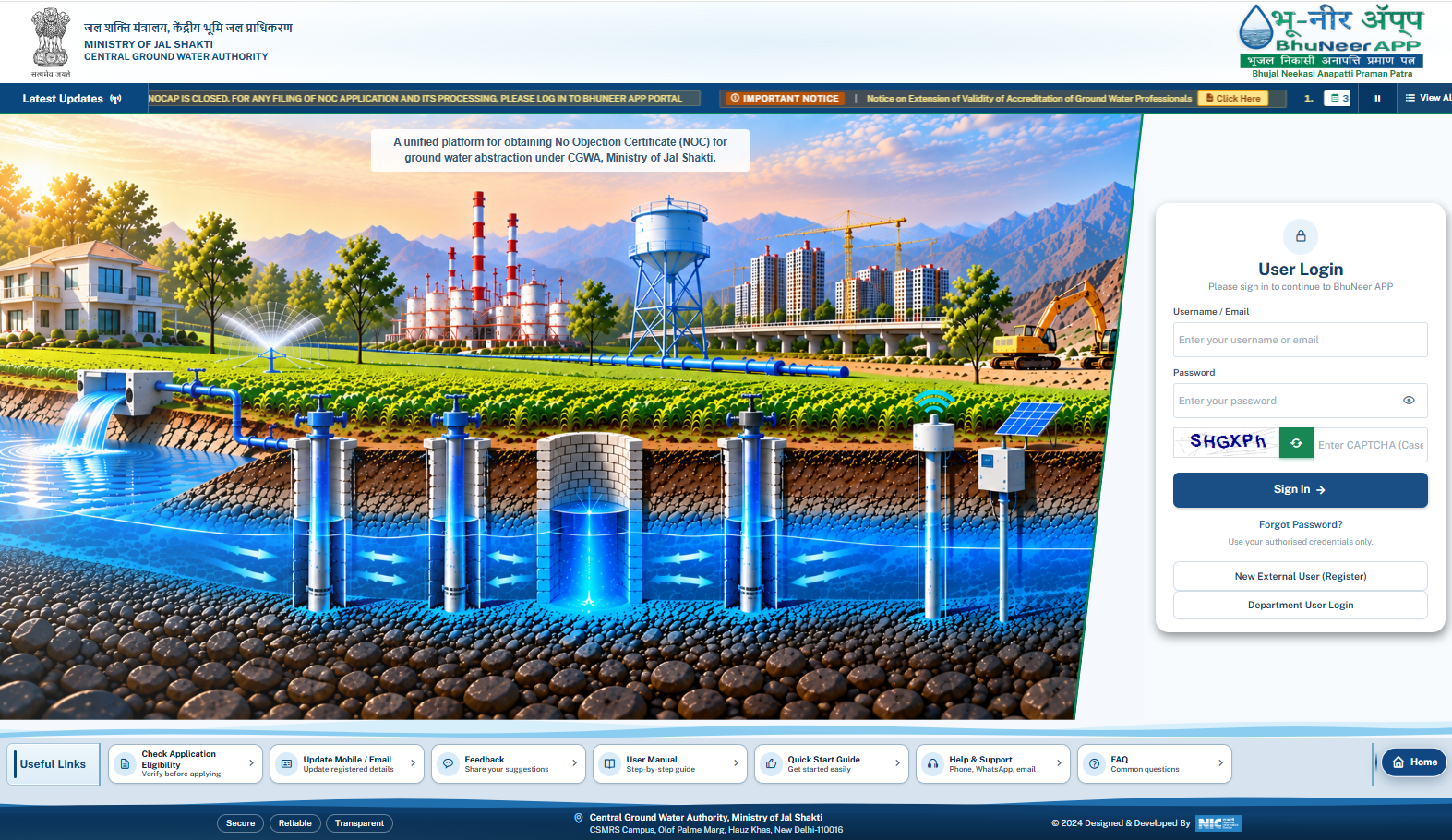
BhuNeer External User Registration & Account Setup

The Ministry of Jal Shakti requires all project proponents to register using an active Company PAN. Follow the visual sequence below to verify contact channels and configure your User and Company profiles.

1

Corporate Entity Registration (Company PAN Mandate)

Navigate to cgwa-bhuneer.mowr.gov.in and click "New External User (Register)". As per official CGWA policy, all registrations must use the Company PAN Number. Individual and HUF PAN cards are strictly disallowed for commercial, industrial, or infrastructure projects. Enter your corporate email and mobile number to receive simultaneous OTPs.

2

Dual-Channel OTP Verification & Profile Configuration

Authenticate your profile using the separate OTPs sent to your mobile SMS and corporate email. Set your password and complete your permanent User Profile (authorized signatory identity, state, and district) and Company Profile (registered legal name, corporate GST, and official correspondence address).

3

Drafting Project Parameters & Technical Studies Upload

Click "Apply for Fresh Application" on the left menu. Complete every module: sector details, daily extraction demand (m³/day), proposed operational borewells, and geographical coordinates. Attach mandatory documents: SPCB Consent to Establish (CTE), Municipal Non-Availability Certificate, geotagged RWH drawings, and accredited Impact Assessment Reports (IAR with MODFLOW modeling) if water requirement exceeds 100 KLD.

4

Bharatkosh Payment Gateway & Final Submission

Execute final submission to generate the government challan. Remit statutory processing and abstraction fees through the integrated payment gateway or via Bharatkosh offline payment, uploading transaction proofs for digital wallet verification and final CGWA receipt generation.

LEGACY NOCAP MIGRATION

Importing Old NOCs & Filing Timely Renewals on BhuNeer

Projects holding earlier clearances granted under the legacy NOCAP system must import their data onto BhuNeer to avoid expiry, illegal extraction classification, and compounding daily Environmental Compensation charges.

1

Observe the 90-Day Pre-Expiry Filing Window

Under statutory CGWA guidelines, renewal applications can be imported and submitted on BhuNeer starting 90 days prior to the expiration date of the active NOC. Initiating the workflow early ensures sufficient time for fee verification and field inspection reviews.

2

Import Clearance via Old NOCAP Reference Number

Log in with your verified Company PAN account, navigate to "Apply for Renewal Application" on the left menu, and enter your original NOC Number (e.g., CGWA/IND/2021/...). Click "Import Application" to automatically populate previous abstraction limits, well locations, and approved categories.

3

Mandatory Due Payment & Pending Fee Clearance

Before the renewal application unlocks for submission, the imported details are audited by CGWA for pending abstraction or restoration charges. If arrears exist, a payment link generates on your dashboard under "Pending Action". Complete the due payment to unlock the renewal form.

4

Upload Self-Inspection Report & Pre-Renewal Audit

Complete the BhuNeer Self-Inspection Module by uploading daily abstraction Excel logs for the full previous tenure, NABL test reports, telemetric piezometer records, and certified Industrial Water Audit Reports (mandatory for units drawing > 100 KLD) before executing final renewal submission.

STATUTORY PROTOCOLS

BhuNeer Technical Rules: Formats, Revivals & EAC Appraisals

Key regulatory parameters established by Central Ground Water Authority notices governing data attachments, technical appraisals, and rejected file restorations.

DATA FORMATS

Extraction & Level Records

Groundwater withdrawal logs must be uploaded in dual format: editable MS Excel spreadsheet (.xlsx) and signed summary .pdf. Daily, monthly, and annual totals must match your cloud telemetry server database exactly.

AUTHENTICATION

Telemetry Credentials Mandate

Uploading static meter logs alone is insufficient. As per official rules, project proponents must mandatorily input the direct User ID, Password, and Server Portal URL for automated telemetric API syncing with CGWA servers.

LEGAL REVIVAL

60-Day Rejection Remedy

If an application is rejected due to deficient documentation, it can be formally revived within 60 days without paying new application fees. The proponent may rectify technical studies and justification while retaining the original project identity.

EAC APPRAISAL

Maximum 3 EAC Opportunities

For complex mining, dewatering, and high-quantum industrial projects requiring Expert Appraisal Committee (EAC) review of 3D modeling studies, proponents are granted a strict maximum of 3 appearances (2 online and 1 physical hearing).

ACCREDITED ADVISORY

End-to-End BhuNeer Technical Support by NRSM Hydrogeologists

Natural Resource Solution and Management acts as your accredited regulatory partner, eliminating bureaucratic friction, rectifying portal show-cause queries, and ensuring seamless compliance across Rajasthan, Bihar, and all Indian states.

✓

NOCAP Legacy Clearance Migration

Complete reconciliation of historical files, fee audits, and seamless import into the BhuNeer portal ecosystem.

✓

Accredited Technical Studies & Modeling

Preparation of submission-ready Impact Assessment Reports (IAR), Mining CHRs, MODFLOW 3D numerical models, and Certified Water Audits.

✓

Piezometer & Cloud Telemetry Integration

Turnkey supply and configuration of CGWA-compliant digital water flow meters and DWLR telemetry with server credentials.

✓

60-Day Rejection Revivals & Query Rectification

Expert drafting of legal justifications, water balance revisions, and liaison for fast-track file approval.

Facing Portal Difficulties or Due Date Deadlines?

Connect directly with our regulatory hydrogeologists for immediate consultation on your BhuNeer application.

07 / SCIENTIFIC & TECHNICAL STUDIES

CGWA Technical Studies Desk

Technical studies provide the scientific basis for evaluating groundwater conditions, project impacts, abstraction requirements and groundwater management measures.

01
📊

Impact Assessment Reports

Groundwater impact assessment and mitigation planning for applicable projects and regulatory submissions.

02
🌐

Groundwater Modelling

Numerical groundwater flow assessment and model-based evaluation for applicable technical studies.

03
🔬

Comprehensive Hydrogeological Reports

Hydrogeological assessment, aquifer interpretation, groundwater conditions and project-specific technical evaluation.

04
💧

Water Audit & Groundwater Management

Water balance, groundwater abstraction assessment, conservation planning and water management studies.

CGWA REGULATORY CRITERIA & APPLICABILITY MATRIX

Comprehensive Impact Assessment Reports & Modelling Criteria

An Impact Assessment Report (IAR) is a mandatory scientific evaluation under Central Ground Water Authority guidelines. Under current notifications, regulatory scrutiny and the required modeling method depend directly on assessment unit stress, aquifer geology, and draft quantum.

Assessment Unit Category Aquifer Formation Groundwater Draft / Seepage Mandatory Study Type
Over-Exploited / Critical / Semi-Critical Hard Rock / Non-Alluvium >100 to 500 m³/day Analytical Modeling (Cooper-Jacob / Theis)
Over-Exploited / Critical / Semi-Critical Hard Rock / Non-Alluvium >500 m³/day 3D Numerical Modeling (MODFLOW / FEFLOW)
Over-Exploited / Critical / Semi-Critical Alluvium / Soft Rock >100 to 1,000 m³/day Analytical Modeling
Over-Exploited / Critical / Semi-Critical Alluvium / Soft Rock >1,000 m³/day 3D Numerical Modeling
Safe Assessment Units Hard Rock >500 m³/day 3D Numerical Modeling
Safe Assessment Units Alluvium >2,000 m³/day 3D Numerical Modeling
Infrastructure Dewatering Any Hydrogeological Formation All Volumes (Irrespective of Quantum) Numerical Modeling (5 km study radius)
Mining Seepage & Dewatering Any Hydrogeological Formation >500 m³/day Seepage Numerical Modeling (10 km buffer study area)

Core Technical Deliverables Formulated by NRSM Hydrogeologists

  • Demarcation of 5 km or 10 km buffer radius hydrogeological study zone around the project boundary.
  • Subsurface lithological cross-sections, pumping test evaluations, and aquifer transmissivity computations.
  • Micro-watershed groundwater budgeting incorporating total annual extraction, natural base flow, and recharge.
  • Calibrated mitigation framework incorporating artificial recharge structure designs and DWLR piezometric monitoring networks.
ADVANCED SIMULATION

3D Numerical Groundwater Flow & Solute Transport Modelling

Numerical groundwater flow modeling translates complex multi-layered subsurface aquifer dynamics into predictive mathematical simulations. CGWA mandates numerical flow modeling for specified projects to forecast water table impacts over 5 to 25 year operational horizons.

Software Environments & Calibration Norms

  • Industry Standard Engines: Numerical simulations configured using USGS MODFLOW (Visual MODFLOW Flex, MODFLOW-USG, MT3DMS).
  • Steady-State & Transient Runs: Dual-phase calibration matching historical piezometric hydrographs with minimal root mean square error (RMSE).
  • Grid Discretization: Dense telescopic mesh refinement centered on operational borewells and mine pit footprints.
  • Mass Balance Accuracy: Rigorous ZONEBUDGET mass balance checks ensuring total model discrepancy remains strictly under 1%.

Simulated Predictive Outcomes

  • Piezometric cone of depression contours generated for 2, 5, 10, and 25-year pumping periods.
  • Subsurface seepage inflow and dewatering volume forecasting for deep opencast mine benches.
  • Assessment of drawdown interaction with neighboring agricultural tube wells and public water sources.
  • Evaluation of artificial recharge efficiency in arresting localized water level declines.
MINING & DEWATERING

Comprehensive Hydrogeological Reports (CHR) for Mining Projects

Mining operations require specialized hydrogeological evaluation to quantify mine pit dewatering volumes, intercept subsurface aquifer breaches, and assess impacts on surrounding hydrological regimes under Section 14 of the CGWA guidelines.

Statutory Mining Scope

  • Buffer Radius: Detailed study encompassing a 10 km radius core and buffer zone around the mining lease boundary.
  • Bench Seepage Modeling: Year-wise and bench-wise hydrogeological seepage computations based on mine advancement plans.
  • Groundwater Interception: Quantification of base flow alterations resulting from pit intersection with the regional water table.
  • Dewatering Management: Complete treatment, domestic utilization, dust suppression, and excess water discharge planning.

Piezometric Network & Mine Closure Integration

  • Strategic network design for core and buffer piezometers equipped with automated DWLR telemetry.
  • Aquifer vulnerability assessment against acid mine drainage and trace metal contamination.
  • Progressive and final mine pit water reservoir storage planning under Progressive Mine Closure Plans (PMCP).
  • Preparation of defense documentation for Expert Appraisal Committee (EAC) hearings.
CONSERVATION & RENEWAL

Certified Industrial Water Audits & Conservation Blueprints

Under CGWA guidelines and renewal notifications, industrial units drawing substantial groundwater must undergo periodic water audits by certified energy and water auditors to identify consumption inefficiencies, recycle wastewater, and reduce freshwater dependence.

Statutory Water Audit Mandate

  • Mandatory Threshold: All industrial units abstracting more than 100 KLD must submit a Certified Water Audit Report at the time of NOC renewal.
  • Accreditation Norms: Audit must be conducted and stamped by certified water auditors accredited by recognized statutory bodies.
  • Frequency: Typically required once within every NOC validity cycle (every 2 to 3 years).
  • Rebate Evaluation: Quantifies qualification metrics for claiming the 50% statutory tariff rebate during NOC renewal.

Audit Deliverables & Water Balance Analysis

  • Comprehensive facility-wide Sankey diagram and mass-balance water flow schematics.
  • Benchmark evaluation of Specific Water Consumption (m³ per unit of product output) against industrial standards.
  • Performance evaluation of Effluent Treatment Plants (ETP) and Sewage Treatment Plants (STP) for dual-piping reuse.
  • Identification of zero-liquid discharge (ZLD) pathways and cost-benefit feasibility for water-saving interventions.

Need Accredited Technical Reporting for Your CGWA NOC?

Natural Resource Solution and Management (NRSM) provides accredited hydrogeological investigations, calibrated MODFLOW modeling, and certified industrial water audits pan-India.

STATUTORY KNOWLEDGE BASE

Frequently Asked Questions

CGWA & SGWA Regulatory Guidelines, BhuNeer Norms, Modeling & Tariffs

Clear, authoritative answers compiled directly from the Consolidated MoJS Guidelines, 2023 Gazette Amendments, and CGWA Standard Operating Procedures (SOP) to assist industries, infrastructure developers, and mining projects across India.

SECTION 01

Groundwater NOC Applicability, Exemptions & MSME Norms

Criteria governing mandatory approvals, non-requirement thresholds, and Over-Exploited (OE) area policies.

All new, existing, or expanding industrial units, commercial/infrastructure projects, mining operations, bulk water suppliers (private water tankers), government water supply agencies in urban areas, and group housing societies/residential apartments (with or without swimming pools) abstracting groundwater must obtain an NOC from CGWA or the respective State Ground Water Authority (SGWA) via the BhuNeer web portal.

Under Para 1.0 of the Guidelines (as amended), the following categories are exempted from obtaining an NOC:

  • Individual domestic consumers in rural and urban areas for drinking water and domestic uses.
  • Rural drinking water supply schemes.
  • Armed Forces Establishments and Central Armed Police Forces establishments in rural and urban areas.
  • Agricultural activities.
  • Micro and Small Enterprises (MSEs) drawing groundwater less than 10 m³/day (< 10 KLD).
  • All industries, mines, and infrastructure projects drawing groundwater only for drinking/domestic use up to 5 m³/day (5 KLD) across all assessment units.
  • Residential Apartments and Group Housing Societies drawing groundwater up to 20 m³/day for drinking/domestic use (provided no swimming pool exists) and EWS dwelling units under government schemes.

In Over-Exploited (OE) assessment units, groundwater extraction permissions are strictly restricted:

  • New Industries: Banned, except Micro, Small, and Medium Enterprises (MSMEs). Non-MSME new units can only seek permission for drinking/domestic use for their workforce and greenbelt development.
  • Packaged Drinking Water (PDW): New Packaged Drinking Water units are strictly prohibited in OE areas, even if they belong to the MSME category.
  • Expansion: Permitted only for the MSME sector; expansion involving increased groundwater extraction is prohibited for all other existing industries.
  • Mining Projects: Eligible (since mining is location-specific).
  • Infrastructure Projects: Only 7 location-specific infrastructure categories are eligible (SEZs, Metro/Railway/Bus Terminals, Airports/Seaports/Logistics, Highways, Fire Stations, Hospitals, and Educational Institutions).
  • Water/Theme/Amusement Parks: Strictly prohibited from extracting groundwater in OE units.
  • Micro and Small Enterprises (MSEs): Fully exempted from seeking an NOC if their total groundwater withdrawal is less than 10 m³/day (< 10 KLD).
  • New Units in OE Blocks: MSMEs are the only industrial category allowed to set up and extract process groundwater in Over-Exploited assessment units (excluding Packaged Drinking Water).
  • Expansion in OE Blocks: MSMEs are the only industrial sector eligible to apply for expansion involving increased groundwater extraction in OE blocks.

Abstraction of saline groundwater (water with Electrical Conductivity > 5,000 µS/cm at 25°C) is encouraged:

  • Projects abstracting saline groundwater are exempted from paying groundwater abstraction and restoration charges.
  • If withdrawal exceeds 100 KLD, submission of an Impact Assessment Report with Groundwater Modeling is mandatory to monitor the fresh-saline interface and prevent saline up-coning.
  • In case of delayed submission of the application, Environmental Compensation (EC) is charged at rates prescribed for Safe Areas.
SECTION 02

Groundwater Abstraction, Restoration & Rebate Charges

Tariff structures across Safe, Semi-Critical, Critical, and Over-Exploited categories.

Groundwater Abstraction Charges are paid by projects operating in Safe, Semi-Critical, and Critical assessment units based on the quantum of water extracted (Rs./m³). Groundwater Restoration Charges are levied at higher rates on projects operating in Over-Exploited (OE) assessment units to fund regional aquifer replenishment, artificial recharge, and conservation interventions.

For general industries and infrastructure projects (rates in Rs. per m³):

  • Safe Areas: Rs. 1.00 (<200 KLD) | Rs. 2.00 (200 to <1000 KLD) | Rs. 3.00 (1000 to <5000 KLD) | Rs. 5.00 (≥5000 KLD)
  • Semi-Critical Areas: Rs. 2.00 (<200 KLD) | Rs. 3.00 (200 to <1000 KLD) | Rs. 5.00 (1000 to <5000 KLD) | Rs. 8.00 (≥5000 KLD)
  • Critical Areas: Rs. 4.00 (<200 KLD) | Rs. 6.00 (200 to <1000 KLD) | Rs. 8.00 (1000 to <5000 KLD) | Rs. 10.00 (≥5000 KLD)
  • Over-Exploited Areas (Restoration Charges): Rs. 6.00 (<200 KLD) | Rs. 10.00 (200 to <1000 KLD) | Rs. 16.00 (1000 to <5000 KLD) | Rs. 20.00 (≥5000 KLD)

(Note: Packaged drinking water units, mining dewatering, and bulk water supply tankers are subject to separate tariff schedules).

Existing industries, infrastructure units, and mining projects that have constructed and maintained functional artificial recharge structures in compliance with the conditions of their previously granted NOC are eligible for a 50% rebate on their groundwater abstraction or restoration charges at the time of renewal, subject to satisfactory performance and physical site verification.

Under Section 11.0 of the Guidelines, NOC validity is granted for:

  • Infrastructure (Drinking/Domestic) & Urban Water Supply: 5 Years (in Safe, Semi-Critical, Critical).
  • Industries: 3 Years (in Safe, Semi-Critical, Critical).
  • Mining Projects: 2 Years.
  • All Users in Over-Exploited (OE) Areas: 2 Years.

Renewal Window: Proponents must apply for renewal at least 90 days prior to expiry[cite: 21]. If submitted within this window, the NOC is deemed extended until formal renewal is processed.

SECTION 03

Fixed Statutory Penalties for Non-Compliance

Mandatory penalty rates under Section 16.0 (Table 16.1) for violation of NOC conditions.

Standard fixed penalties under Section 16.0 (Table 16.1) include:

  • Non-installation / faulty Digital Flow Meter with telemetry: Rs. 2,00,000
  • Non-disclosure / construction of unauthorized extraction structure: Rs. 2,00,000 per structure
  • Reporting freshwater zones as brackish/saline in application: Rs. 2,00,000
  • Non-installation of Piezometer: Rs. 2,00,000
  • Non-installation / faulty DWLR / Telemetry system: Rs. 1,00,000
  • Non-construction / inadequate capacity of Recharge structures: Rs. 5,00,000
  • Non-maintenance of Water Conservation / Recharge structures: Rs. 2,00,000
  • Injection of treated/untreated water into aquifer: Rs. 10,00,000 (+ aquifer remediation costs under EPA 1986)
  • Non-submission of Self-Compliance Report: Rs. 1,00,000
  • Non-submission of Water Level / Quality Data: Rs. 50,000
  • Non-registration of water supply tankers: Rs. 5,00,000

Under Table 16.2 of the Guidelines, fees payable via Bharatkosh for modifications are:

  • Change in User ID: Rs. 5,000
  • Change in Firm Name: Rs. 5,000
  • Extension of NOC (maximum 2 years for genuine construction delays): Rs. 5,00,000
  • Issuance of Duplicate NOC: Rs. 5,000
  • Issuance of Corrigendum to NOC: Rs. 5,000
  • Any other corrections / administrative modifications: Rs. 5,000
SECTION 04

Environmental Compensation (EC) & Unauthorized Extraction

Formulas, deterrence factors, and late submission penalties for unpermitted abstraction.

Extracting groundwater without a valid NOC attracts daily Environmental Compensation calculated under Section 15.0 as:

ECGW = Daily Consumption (m³/day) × ECRGW (Rate in Rs./m³) × Number of Days × Deterrence Factor
  • Minimum EC: Cannot be less than Rs. 1,00,000 in any case.
  • ECR Rates for Industries (Table 15.3): Ranges from Rs. 20 to Rs. 200 per m³ based on abstraction quantum and block category.
  • Deterrence Factor (Table 15.4): Multipliers of 1.00 to 2.00 apply based on the duration of illegal extraction (<2 yrs, 2–5 yrs, >5 yrs) and extraction quantum.

Existing units that operated prior to statutory cut-offs without applying before the designated deadline face retroactive Environmental Compensation (EC) from 24.09.2020 (or date of commencement) plus a mandatory Late Submission Fee of Rs. 1,00,000. Renewal applications delayed by more than 3 months after expiry also attract daily EC until renewed.

SECTION 05

Technical Studies, Modeling, Piezometers & Audits

Requirements for IAR, CHR, Visual MODFLOW simulations, DWLR piezometers, and water balance audits.

Under amended Para 4.1(f), an Impact Assessment Report (IAR) covering a 5 km radius prepared by an accredited consultant is mandatory for:

  • In Over-Exploited, Critical, and Semi-Critical (OCS) units: All projects extracting in excess of 100 m³/day (> 100 KLD).
  • In Safe assessment units:
    • Non-alluvium / Hard rock terrain: Extraction exceeding 500 m³/day (> 500 KLD).
    • Alluvium / Soft rock terrain: Extraction exceeding 2,000 m³/day (> 2,000 KLD).
  • Infrastructure Projects involving Dewatering: Mandatory for all projects involving dewatering regardless of quantum.

As per CGWA SOP (Appendix-A), the modeling criteria are:

  • Analytical Modeling (e.g., Theis, Cooper-Jacob, Walton): Permitted for industries in OCS areas extracting between > 100 to 500 KLD in Hard Rock, and between > 100 to 1,000 KLD in Alluvium.
  • Numerical Modeling (e.g., Visual MODFLOW, FEFLOW): Mandatory for:
    • Industries in OCS units drawing > 500 KLD (Hard Rock) or > 1,000 KLD (Alluvium).
    • Industries in Safe units drawing > 500 KLD (Hard Rock) or > 2,000 KLD (Alluvium).
    • Mining projects with groundwater seepage component > 500 KLD.
    • Infrastructure dewatering projects of any quantum.

All mining projects applying for a Groundwater NOC (fresh or renewal, with or without dewatering) must submit a Comprehensive Hydrogeological Report (CHR). The report covers hydrogeology in the core zone (2 km radius) and buffer zone (10 km radius), year-wise mine pit seepage computations, socio-economic impact assessments, and mine-water gainful utilization plans.

Reports must strictly be prepared, signed, and stamped by accredited consultants certified under:

  • RGNGWTRI (Rajiv Gandhi National Ground Water Training and Research Institute, Raipur) for Individuals and Institutions.
  • NABET / QCI (National Accreditation Board for Education and Training, New Delhi) for Institutions.

Reports from non-accredited entities are rejected during the initial verification stage.

Under amended Section 14.0 (Table 14.1), in non-notified/non-industrial areas, piezometer requirements are:

  • Withdrawal ≤ 100 m³/day (≤ 100 KLD): No piezometer required.
  • Hard Rock Aquifers (> 100 KLD): 1 Piezometer with DWLR and Telemetry installed at a minimum distance of 15 m from the pumping well tapping the same aquifer zone.
  • Alluvium Aquifers (> 500 KLD): 1 Piezometer with DWLR and Telemetry installed at a minimum distance of 50 m from the pumping well.
  • Mining Projects (> 100 KLD): Mandatory piezometers in both core and buffer zones.

Under amended Para 4.1(iii), all industries abstracting groundwater in excess of 100 m³/day (> 100 KLD) must conduct a biennial water audit (once every 2 years) through CGWA-approved certified auditors (CII, FICCI, NPC) and submit the report within 3 months. All such units are legally mandated to reduce their groundwater consumption by at least 20% over 3 years.

  • Consent to Establish (CTE) / Consent to Operate (CTO) / Environmental Clearance (EC)[cite: 11].
  • Water availability proof: Notarized affidavit for requirement ≤ 10 KLD; Non-availability certificate from public water supply agency for requirement > 10 KLD[cite: 11].
  • Udyam / MSME Certificate (mandatory for all units applying in OE areas)[cite: 11].
  • Rooftop Rainwater Harvesting (RWH) / Recharge Plan as per Model Building Bye-Laws[cite: 11].
  • IAR and GW Modeling Report (if abstraction exceeds thresholds)[cite: 11].
  • NABL Water Quality Report (mandatory for saline groundwater claims)[cite: 11].
  • Bharatkosh payment receipts for application fee and 1-year advance abstraction/restoration charges[cite: 20].
⚖️

Regulatory Framework & Legal Citations Basis

All regulatory criteria, technical thresholds, fee tariffs, and penalty structures presented across this knowledge base are directly derived from and legally governed by official notifications issued by the Ministry of Jal Shakti (MoJS), Department of Water Resources, RD & GR, Government of India:

MoJS Gazette Notification S.O. 3289(E) Dated 24.09.2020: Pan-India guidelines regulating groundwater extraction and dewatering.
Amendment Gazette Notification S.O. 1509(E) Dated 29.03.2023: Revised exemption slabs, DWLR piezometer limits, and modeling thresholds.
CGWA Standard Operating Procedure (SOP v9.1) Dated 14.05.2023: Operational guidelines and Appendix-A specifications for IAR, CHR & Numerical Modeling.
CGWA Public Notices & BhuNeer Directives Public Notices No. 08/2022 & 10/2022 regarding advance charges, late fee imposition, and digital single-window migration.
EXPERT ADVISORY

Need Custom Guidance on Your Project's CGWA / SGWA Status?

Our senior hydrogeologists provide free compliance reviews, water budget audits, and BhuNeer application filing assistance.